
What Are the Best Digital Marketing Strategies for Manufacturing and Service Brands in 2026?
September 28, 2026
Business Blog Topics: 10 Proven Benefits for Your Site
September 28, 2026
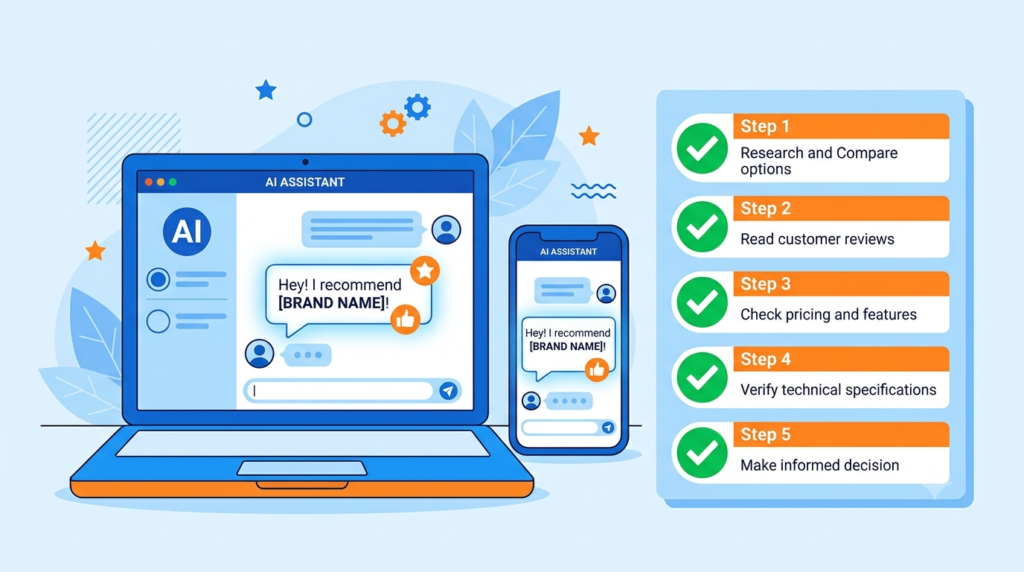
A few years ago, getting found online meant climbing to the first page of Google. Today, a customer can simply ask an AI tool, “Which company should I hire to build my website?” and get a short list of names in seconds. If your brand isn’t on that list, you’re invisible at the exact moment someone is ready to choose. That’s why AI search has become a serious priority for business owners in 2026.
The good news is that getting recommended by AI search isn’t magic, and it isn’t reserved for giant brands. It comes down to being clear, consistent and genuinely helpful. In this guide, the team at VK Info Tech shares a simple 5-step checklist you can start working through today.
What Is AI Search and Why Does It Matter?
AI search is any search experience where an AI tool gives a direct, conversational answer instead of only a list of links. Think of Google’s AI Overviews and AI Mode, ChatGPT, Gemini, Perplexity and Copilot. Instead of ten blue links, the person gets a short summary, often with a few brands or sources mentioned along the way.
That changes the game in a quiet but important way. People tend to trust a direct recommendation more than a long list of options, and they often act on it faster. Being named in an AI answer can put your business in front of a motivated buyer before they ever open your website.
How Does AI Search Decide What to Recommend?
Nobody outside these companies knows the exact formula, and anyone who promises you a guaranteed spot is guessing. Still, the pattern is clear enough to work with. AI tools tend to lean on content that is easy to understand, backed by credible sources and consistent across the web.
Google itself says that the usual SEO fundamentals still apply to its AI features, and that helpful, people-first content matters most. In plain words, you don’t need a secret trick. You need a website and a brand that are easy to trust. You can read Google’s own advice in its guide on AI features and your website.
Step 1: Check Where You Stand Today
Before you fix anything, find out what AI actually says about your brand right now. You can’t improve what you haven’t measured.
The 5-Step Checklist to Get Recommended by AI Search
Work through these steps in order. Each one builds on the one before it.
Step 1: Answer Real Customer Questions Clearly
Start with the questions your customers actually ask on calls, in chats and in emails. “How much does a website cost?” “How long does an app take to build?” “Which platform is best for my store?” Write a page or a section for each one, and put a short, direct answer in the first two or three sentences. Then add the details underneath.
This works because AI tools look for passages that answer a question cleanly. If your answer is buried under five paragraphs of introduction, it’s easy to skip.
Step 2: Make Your Brand Easy to Understand and Consistent
An AI tool can only recommend what it can clearly identify. Make sure your business name, services, location, contact details and one-line description say the same thing everywhere: your website, Google Business Profile, LinkedIn, directories and social pages.
Add a proper About page and a Services page that explain who you help and how. Vague lines like “we provide innovative solutions” say very little. A line like “we build fast WordPress and e-commerce websites for small businesses” says a lot.
Step 3: Fix the Technical Basics and Use Structured Data
Before anything else, make sure search engines and AI tools can actually reach your pages. Check that your important pages are indexable, that your robots.txt file isn’t blocking them by mistake, that your site loads fast on mobile, and that your internal links connect related pages.
Then add structured data (schema markup) such as Organization, Article, FAQ and Local Business where it fits. Keep one rule in mind: the markup must match what visitors can actually see on the page. Structured data helps machines read your content, but it isn’t a shortcut on its own.
Step 4: Build Trust Beyond Your Own Website
AI tools don’t rely only on what you say about yourself. They also notice what others say about you. Collect genuine customer reviews, publish case studies you can honestly stand behind, share expert advice on LinkedIn, and aim to be mentioned in industry blogs, podcasts and trusted directories.
Show the real people behind the brand too. Author names, short bios and clear credentials make content feel trustworthy to readers and machines alike.
Step 5: Track, Test and Refresh Regularly
Once a month, ask the AI tools your customers use the exact questions you want to be recommended for. Note which brands show up, which sources get mentioned and where you’re missing. Use Google Search Console to see how your pages perform, and update older posts with fresh examples and current information.
Treat this as an ongoing habit, not a one-time project. AI tools keep changing, and your content should keep improving along with them.
Your Quick AI Search Checklist
Here’s the short version you can save or print:
Write clear answers to the top 10 questions your customers ask
Put the direct answer in the first two or three sentences
Keep your business name, services and contact details identical everywhere
Publish detailed About, Services and FAQ pages
Make sure your pages are crawlable, fast and mobile-friendly
Add structured data that matches your visible content
Collect real reviews and earn mentions on trusted sites
Test AI tools monthly and update your content based on what you learn
Common Mistakes That Keep Brands Out of AI Search
Even strong businesses slip up here. These are the mistakes we see most often:
Writing vague, buzzword-heavy copy that never says what you actually do
Publishing thin pages just to chase keywords
Blocking crawlers by mistake in robots.txt
Letting business details go out of date on directories and social pages
Posting AI-written content without adding real experience or opinions
Expecting overnight results from a few quick edits
Fixing even two or three of these can make your brand clearer, easier to trust and easier to recommend.
Frequently Asked Questions About AI Search
What is AI search?
AI search is a way of finding information where an AI tool gives a direct, conversational answer, often with sources or brand mentions, instead of only showing a list of links.
Can I guarantee my brand gets recommended?
No. Nobody can honestly promise that. What you can do is make your content clearer, your brand details more consistent and your reputation stronger, which improves your chances over time.
Is AI search different from traditional SEO?
They overlap a lot. Strong SEO basics like helpful content, fast pages and clean technical setup still matter. The difference is that AI answers are more conversational and lean heavily on trust and clarity.
How long does it take to see results?
There’s no fixed timeline. Most businesses need weeks or months of steady work, because content has to be published, found and trusted before it gets recommended.
Can small businesses compete in AI search?
Yes. A small business with clear expertise, real reviews and a well-defined niche can beat a bigger brand that publishes vague, generic content.

1 Comment
ytyuioiuguioihghj