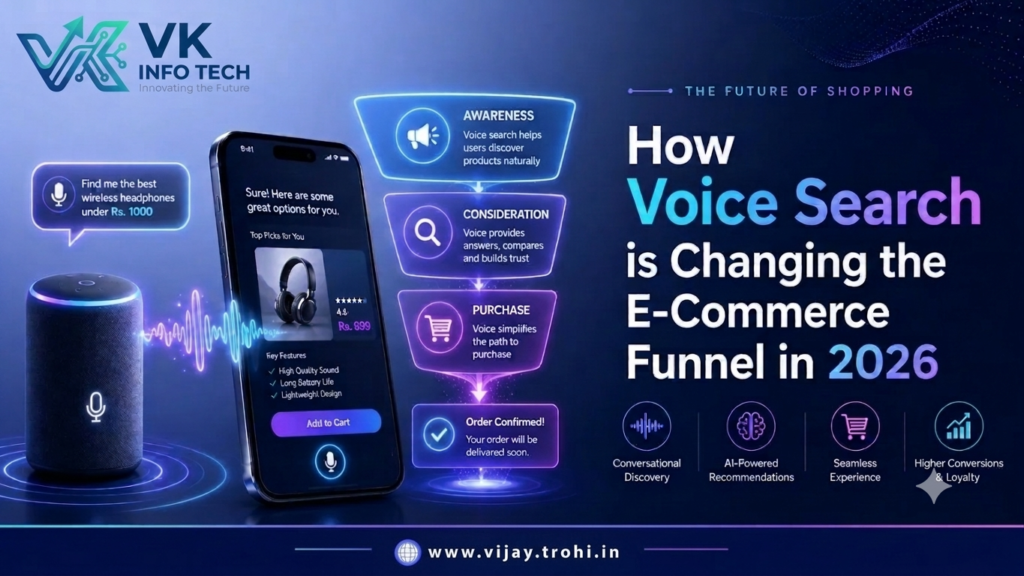

How Voice Search Is Changing the E-Commerce Funnel in 2026
September 29, 2026
SEO Services in Jaipur
October 23, 2026
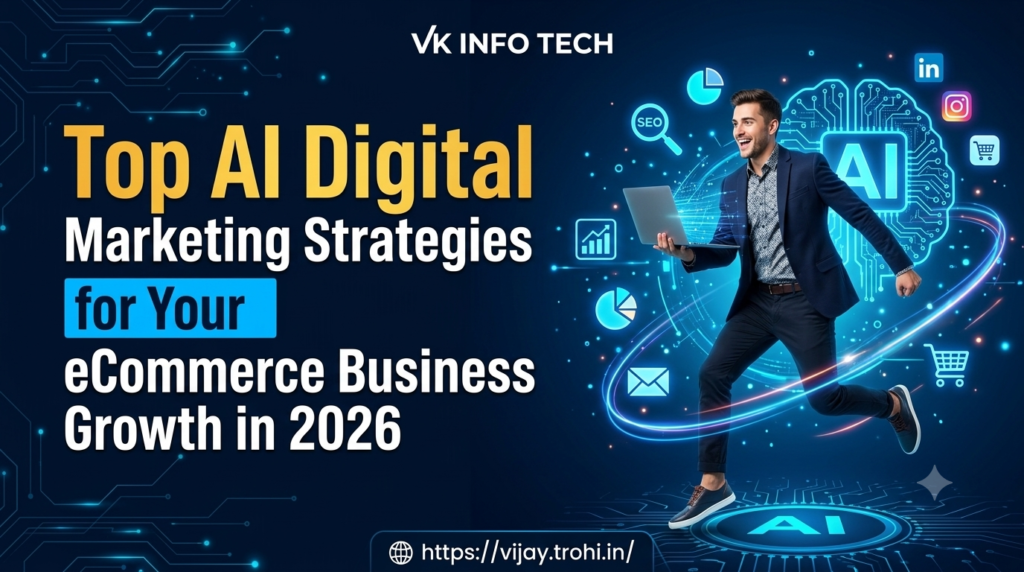
If you want your online store to grow in 2026, the right AI digital marketing strategies for eCommerce can make the difference between guessing and growing. Shoppers now expect the right product, at the right price, on the right channel, at the right moment. Delivering that manually to thousands of visitors and hundreds of products is impossible, and that is where artificial intelligence steps in..
AI is no longer an experiment reserved for big brands. Platforms like Shopify and WooCommerce, ad networks like Google and Meta, and most email tools now ship with built-in AI features, which puts powerful automation in the hands of small and mid-sized stores too. The brands that use these tools well spend less time on repetitive tasks and more time on strategy, creativity and their customers.
In this guide, VK Info Tech breaks down the top AI marketing for eCommerce strategies for 2026, including how to start with each one, which metrics to track, and which mistakes to avoid.
Why AI Digital Marketing Strategies for eCommerce Matter in 2026
Competition in online retail is tougher than ever. Ad costs keep rising, customers compare options in seconds, and attention is hard to hold. AI helps in three clear ways:
- Speed: It analyzes data and runs tests far faster than any team can.
- Relevance: It tailors messages and offers to each shopper.
- Efficiency: It automates repetitive work so your team can focus on big-picture eCommerce marketing in 2026.
1. Hyper-Personalization Across Your Store
AI personalization means showing every visitor a version of your store that fits their interests. AI models study browsing history, past purchases, location, device and real-time behavior to decide what each person sees, so a first-time visitor and a loyal customer never get the same experience.
Areas where AI personalization works best:
- Product recommendations such as “you may also like” and “frequently bought together”
- Homepage banners and collection order
- On-site search results that learn from clicks and purchases
- Email and push notification content
- Offers tailored to the shopper’s stage (new, returning or VIP)
How to start: Turn on the recommendation features in your platform or try a dedicated tool such as Nosto or Rebuy. Begin with product pages and the cart page, and A/B test every change.
2. Optimize for AI Search (GEO and AEO)
More shoppers now begin product research inside AI assistants and AI-generated search summaries instead of scrolling through a list of links. Generative Engine Optimization (GEO) and Answer Engine Optimization (AEO) focus on making your brand easy for these systems to understand, trust and recommend.
What to do:
- Write specific product descriptions that answer real questions: size, material, use case, compatibility, care instructions
- Add structured data (Product, Offer, Review and FAQ schema)
- Keep your Google Merchant Center product feed accurate and complete
- Encourage detailed customer reviews
- Publish buying guides, comparisons and FAQ pages
- Earn mentions on trusted websites, blogs and review platforms
No one can guarantee a spot in AI answers, so the practical goal is simple: be the most helpful, accurate and trustworthy source in your niche.
3. Generative AI for Content at Scale
Generative AI can draft product descriptions, blog outlines, ad copy, email subject lines and social captions in minutes. For stores with large catalogs, this removes one of the biggest bottlenecks in marketing.
The secret is to treat AI as a first-draft writer, not a final publisher. Create a short brand voice guide, give the AI your real product details and unique selling points, and always have a human edit for accuracy, tone and originality. Unedited, generic content will not help your SEO or your brand.
How to start: Pick one content type, such as product descriptions for a single collection, and build a repeatable prompt and review process before expanding.
4. AI Chatbots and Conversational Commerce
AI chatbots for eCommerce can answer questions around the clock on your website, WhatsApp, Instagram and Messenger. They can help with order tracking, size and fit advice, product recommendations, return policies and even recovering abandoned carts.
Good chatbots do three things well: they use your real store data, they give short and clear answers, and they hand the conversation to a human when a customer is frustrated or the question is complex. A smart handoff protects customer trust.
How to start: Review your most common support questions, build the assistant around those first, and check chat transcripts weekly to improve its answers.
5. Predictive Analytics and Smart Segmentation
Instead of looking back at what happened, predictive analytics estimates what is likely to happen next. AI can forecast customer lifetime value, flag shoppers who are about to churn, and predict who is most likely to buy again soon.
Practical uses:
- Build a VIP segment of high-value customers for early access and loyalty rewards
- Launch win-back campaigns for customers at risk of leaving
- Shift ad budget toward audiences that bring the most long-term value
- Forecast demand so your marketing and inventory stay in sync
How to start: Clean your customer data, set up RFM (recency, frequency, monetary) segments, and use the predictive features in your email or analytics platform.
6. AI-Powered Advertising and Creative Testing
Automated campaign types such as Google Performance Max and Meta Advantage+ use machine learning to choose placements, audiences and bids. AI tools can also generate many creative variations, so you can test headlines, images and videos far faster than before.
Automation only works as well as the signals you feed it. To get better results:
- Keep your product feed titles, images and prices accurate
- Track conversions correctly and share first-party data where privacy rules allow
- Set clear guardrails such as budget limits, brand exclusions and target return on ad spend
- Give campaigns enough time to learn before making big changes
- Always review creative for accuracy and brand fit
7. Smarter Email, SMS and WhatsApp Marketing Automation
Owned channels remain among the most profitable parts of many online stores, and AI email marketing makes them sharper. It can pick the best send time for each subscriber, test subject lines automatically, and build predictive segments without manual work.
The most valuable automated flows to set up:
- Welcome series for new subscribers
- Browse abandonment reminders
- Cart abandonment recovery
- Post-purchase thank-you and review requests
- Replenishment reminders for repeat-purchase products
- Win-back flows for inactive customers
Always collect clear consent and follow the privacy and messaging rules that apply in your markets.
8. Dynamic Pricing and Smart Promotions
AI can recommend price and discount changes based on demand, stock levels, competitor pricing and your profit margin. It can also decide which shoppers genuinely need a discount to convert, so you stop giving blanket offers to people who would have bought anyway.
Pricing is sensitive, so set guardrails: minimum margins, price floors, and rules that keep your pricing fair and consistent. Customers who feel tricked by sudden price swings may not come back.
How to start: Test AI-assisted promotions on a small group of products or a single customer segment and measure profit, not just sales.
9. Visual AI: Product Imagery, Video and Virtual Try-On
Visual content drives online purchases, and AI has made it much cheaper to produce. Stores now use AI to create clean product backgrounds, lifestyle scenes, short promotional videos, virtual try-on experiences and visual search, where shoppers upload a photo to find similar items.
One rule matters above all: your images must represent the real product honestly. Misleading visuals lead to returns, bad reviews and lost trust. Use AI to enhance your photography, not to replace the truth.
10. AI for Reviews, User-Generated Content and Social Listening
Customer feedback is full of insight, but nobody has time to read thousands of reviews. AI can summarize reviews, detect sentiment, and highlight recurring complaints about sizing, quality or delivery, which helps both your marketing and your product decisions.
Social listening tools use AI to spot trending topics, track brand mentions and find customers already talking about your products. You can then feature the best user-generated content on product pages, ads and social channels, always with the creator’s permission.
Your 90-Day AI Marketing Roadmap
Trying everything at once leads to confusion. Follow a simple phased plan instead:
- Days 1 to 30 (Foundation): Audit your tracking, product feed and customer data. Fix errors, confirm consent settings, and launch one or two quick wins such as cart abandonment emails or a basic chatbot.
- Days 31 to 60 (Growth): Add on-site personalization, set up automated ad campaigns, and build a human-reviewed AI content workflow.
- Days 61 to 90 (Scale): Improve your product pages for AI search, add predictive segments, review results, and double down on what is working.
Common Mistakes to Avoid
- Automating without a strategy: AI amplifies your plan. If the plan is unclear, it only amplifies the confusion.
- Publishing unedited AI content: Generic or inaccurate content can hurt rankings and credibility.
- Ignoring data privacy: Respect consent and comply with regulations such as GDPR or India’s DPDP Act wherever they apply.
- Adopting too many tools at once: Master one tool, prove its value, then add the next.
- Trusting platform reports blindly: Compare ad platform numbers with your store’s actual revenue and profit.
- Removing the human touch: Customers still value real support, real stories and real brand personality.
Key Metrics to Track
- Conversion rate and average order value (AOV)
- Customer acquisition cost (CAC)
- Return on ad spend (ROAS) and marketing efficiency ratio (MER)
- Customer lifetime value (CLV) and repeat purchase rate
- Revenue per email, SMS or WhatsApp recipient
- Cart recovery rate
- Customer support resolution time and satisfaction score
How VK Info Tech Can Help You Put AI Marketing into Action
Knowing the strategies is the first step. Putting them to work across your website, ads, email and analytics takes planning and the right technology. VK Info Tech can support your eCommerce business with:
- eCommerce website design and development
- SEO and AI search (GEO) optimization
- AI-powered marketing automation for email, SMS and WhatsApp
- Performance marketing and ad campaign management
- Analytics, tracking and reporting setup
Whether you are launching a new store or scaling an existing one, the VK Info Tech team can help you choose the right starting point and build a clear, practical plan.
Frequently Asked Questions
What is AI digital marketing for eCommerce?
It is the use of artificial intelligence to plan, run and improve online store marketing, including personalization, advertising, email automation, content creation, customer support and analytics.
Is AI marketing affordable for small eCommerce stores?
Yes. Many platforms include AI features in their existing plans, and several tools offer free or low-cost entry tiers. Start with one high-impact area instead of buying a full stack.
Will AI replace digital marketers?
No. AI handles repetitive and data-heavy tasks, while people provide strategy, creativity, brand judgment and customer empathy. Marketers who learn to work with AI will have a clear advantage.
Which AI strategy should I start with first?
For most stores, automated email or WhatsApp flows and a clean product feed give the fastest, most reliable returns. From there, add personalization and ad automation.
How can I optimize my store for AI search?
Write detailed, honest product descriptions, add structured data, keep your product feed accurate, collect quality reviews, and publish helpful guides that answer your customers’ real questions.
How can VK Info Tech help with AI marketing for my eCommerce store?
VK Info Tech can help you plan and run AI-driven marketing, from website and SEO improvements to email and WhatsApp automation and ad campaigns. Contact the team to discuss your store’s goals and find the right starting point.
Conclusion
AI will not replace a great product or a great brand, but in 2026 it is one of the most powerful ways to grow an online store efficiently. From personalization and AI search to smarter ads, automated messaging and predictive analytics, the AI digital marketing strategies for eCommerce in this guide help you understand customers better and serve them faster.
Start small, fix your data, measure what matters, and keep a human in the loop. Pick one strategy from this list and put it into action this week. Small, consistent AI-powered improvements add up to real growth.