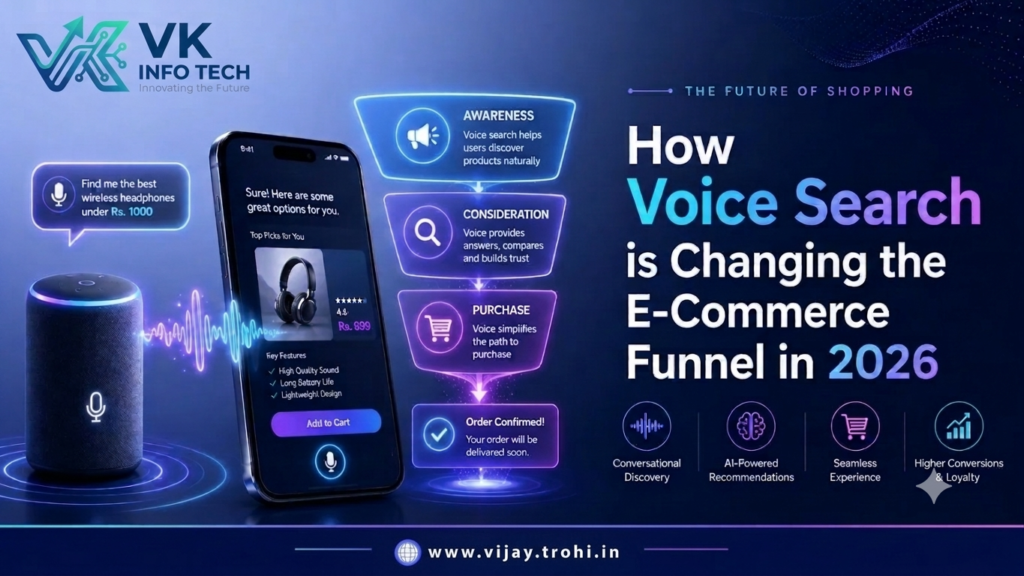
Ask a friend to recommend a good pair of running shoes and they won't answer in keywords. They'll just talk. Shoppers are starting to do the same with their phones and smart speakers, and that's exactly why voice search is rewriting the way people find, compare and buy products online in 2026.
If your store still treats the funnel as a neat line of "search, click, scroll, buy," this shift can feel uncomfortable. The good news is that once you see where voice search changes shopper behavior, you can fix the weak spots one stage at a time. This guide walks you through the changes, the opportunities and a practical plan from the team at VK Info Tech.
What Voice Search Means for Online Shopping
Voice search simply means speaking a query instead of typing it. A shopper might say, "Which moisturizer works best for dry skin and won't break the bank?" instead of typing "best moisturizer dry skin." The query is longer, more natural and usually carries a clear intent.
That small difference matters. Spoken questions tend to be specific, and they often include a budget, a location or a deadline. In other words, voice search can bring you shoppers who are closer to a decision, but only if your store can answer in plain language.
The Traditional Funnel vs. the Voice-First Funnel
The classic e-commerce funnel moves through awareness, consideration, decision and loyalty. Voice search doesn't delete those stages. It compresses them and changes what happens inside each one.
| Funnel Stage | Typed Search | Voice Search |
|---|
| Awareness | Short keywords, many results | Full questions, one spoken answer |
| Consideration | Open tabs and compare manually | Ask follow-up questions |
| Decision | Add to cart and fill in forms | Reorder or buy with fewer taps |
| Loyalty | Emails and app notifications | Quick spoken updates and repeat orders |
7 Ways Voice Search Is Changing the E-Commerce Funnel
1. Awareness Becomes Conversational
People ask questions the way they would ask a shop assistant. Your product pages and blog posts need to answer those questions directly, in simple sentences, near the top of the page.
2. One Answer Replaces Ten Results
A screen shows ten results. A speaker usually reads out one. That makes visibility a winner-takes-most game, so clear, well-structured and trustworthy content gets a real edge.
3. Consideration Happens by Asking
Instead of opening five tabs, shoppers ask follow-ups like "Is it waterproof?" or "Does it come in black?" Stores that publish sizes, materials, specs and return details in plain language are easier for assistants to pull from.
4. Local Intent Gets Stronger
"Near me" and "open now" are very common in spoken searches. If you run a local or hybrid business, an accurate Google Business Profile, address and set of opening hours can decide whether you get mentioned at all.
5. Repeat Buying Gets Easier
Groceries, beauty refills, pet food and other everyday items suit voice shopping best because the buyer already knows what they want. Saved preferences and easy reorder flows turn a one-time customer into a regular.
6. Checkout Friction Matters More
Someone who began with a quick spoken question won't tolerate a slow, twelve-field checkout. Fast mobile pages, guest checkout and saved payment options protect the sale at the very last step.
7. Loyalty Moves Beyond the Inbox
"Where's my order?" is one of the most natural questions to ask out loud. Clear tracking, simple support answers and a consistent brand voice keep the relationship going after the purchase.
How to Optimize Your Store for Voice Search
You don't need to rebuild your website. Start with these practical steps:
- Target question-based keywords. Use your customer chats and search tools to find the "who, what, which and how" questions shoppers actually ask.
- Add a short FAQ to key pages. Answer each question in two or three plain sentences.
- Use structured data. Product, review, FAQ and local business markup help search engines understand your pages. Google explains the basics in its structured data guide.
- Speed up your mobile experience. Many voice searches start on a phone, so slow pages cost you twice.
- Write product titles and descriptions like people talk. Mention size, color, use case and who the product is for.
- Keep local details accurate. Your address, timings, phone number and delivery areas should match everywhere online.
Common Voice Search Mistakes Online Stores Make
Even good stores trip up here. The most common mistakes are:
- Writing only for typed keywords and ignoring full questions
- Hiding answers deep inside long paragraphs instead of leading with them
- Ignoring page speed on mobile devices
- Leaving business details outdated or inconsistent
- Skipping structured data because it looks too technical
Fixing even two or three of these can make your store easier to find and easier to trust.
What's Next for Voice Search in E-Commerce
Assistants are getting better at understanding context, remembering preferences and handling follow-up questions. For online stores, that points to a future where being the clearest and most helpful source matters more than stuffing in the most keywords. Brands that invest in useful content and clean data now are likely to be the ones assistants mention later.
Frequently Asked Questions About Voice Search
What is voice search in e-commerce?
It's when shoppers use spoken questions or commands, through a phone or smart speaker, to find products, compare options or place orders instead of typing.
Does voice search affect SEO?
Yes. Spoken queries are longer and more conversational, so content that answers real questions clearly tends to match them better than keyword-stuffed pages.
How can a small online store optimize for voice search?
Start with question-based keywords, add short FAQs to your main product and category pages, keep local information accurate and make sure your site loads fast on mobile.
Will voice search replace typed search?
Unlikely. Most shoppers will use both, depending on the moment, so a smart strategy supports typed and spoken searches together.
Final Thoughts: Make Voice Search Part of Your Funnel
Voice search isn't a gimmick sitting off to the side of e-commerce. It's changing how shoppers discover products, how they compare them and how quickly they decide. Stores that answer questions clearly, load fast and stay consistent will be easier to find and easier to choose.
Want help auditing your store for voice search? The team at